

All Roads Lead to the South
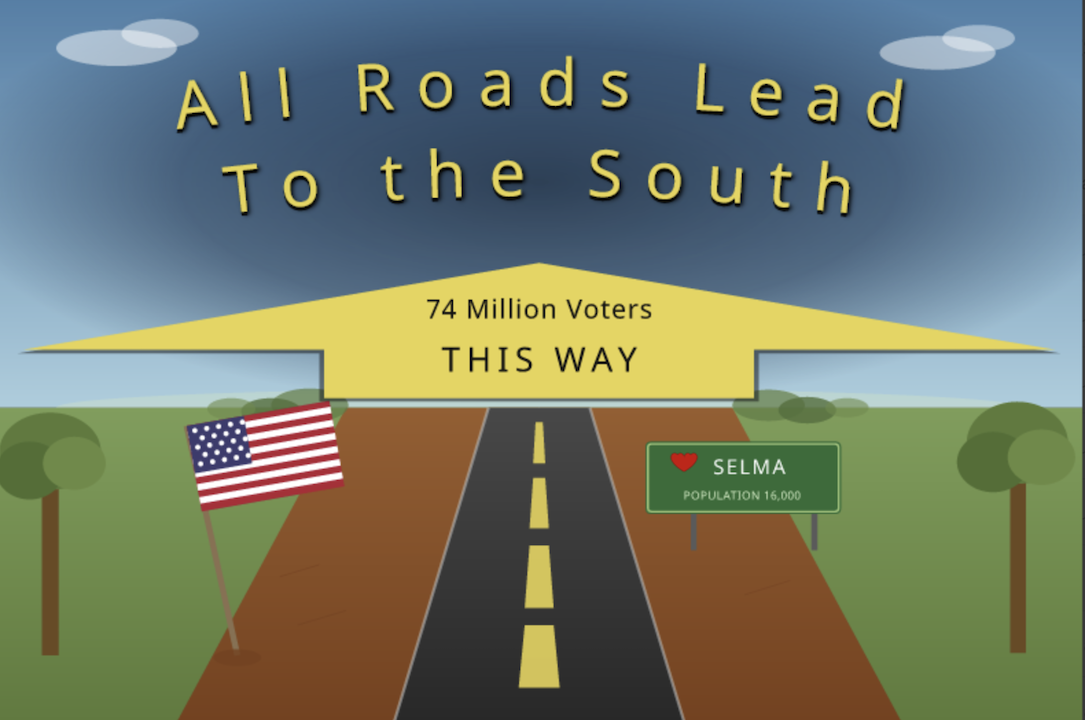
Illustration by Alice Bond
By Alice Bond and LaMar Holliday
Sometimes it feels like Juneteenth all over again — not the unease of enslaved people whose freedom was declared but withheld in Texas, but something even darker. Today people are watching their voting rights being gutted by those who know exactly what they are doing.
We are living in a world of a thousand cuts, but this one cuts to the bone. On April 29, 2026, the U.S. Supreme Court's ruling in Louisiana v. Callais stripped away Section 2 of the historic 1965 Voting Rights Act. It was the last functioning leg of the act that civil rights leaders and activists fought and died for to ensure Black Americans could vote.
This decision has unleashed Republicans across the country into a surreal partisan race to see who is fastest at eviscerating voting districts in majority Black districts. It is a purposeful tactic. Real world effects were sharp and direct, with speed gerrymandering beginning in Tennessee, Louisiana and Florida as soon as the day the verdict was issued.
On May 16, 2026, a crowd of 7,000, including a group of the original 1965 Civil Rights Movement marchers, protested the decision at an "All Roads Lead to the South" rally and march across the Edmund Pettus Bridge in Selma, Alabama. Demonstrators climbed the same blind arch of the Pettus bridge that prevented the marchers of three heroic protests in 1965 from seeing the armed troopers with batons until it was too late to avoid being beaten.
Listen to the voices of today’s marchers
Justin Jones and Justin Pearson, Tennessee state legislators known famously as “the two Justins” were at the forefront of the recent protest. Both rose to national prominence in 2023 by protesting gun violence on the Tennessee House floor. Both were expelled, then reinstated — and now are living icons of the democratic suppression they fight nationally.
In response to the ruling, Pearson called it "one of the most significant attacks on Black voter participation and Black voter representation since the end of Reconstruction." Jones was equally direct: "When I walked into the House floor last Thursday it was 2026, when I walked off the House floor it was pre-1965. This is not about partisanship, this is about race — and it's being done with unrelenting vigor and determination."
The national outcry from other leading voices on civil rights and voting was swift. Janai S. Nelson of the NAACP Legal Defense Fund, who argued for the representative rights of Black Voters before the U.S. Supreme Court in the case, warned that "fair districts across the nation will likely vanish as legislatures aim to gut representation for voters of color without checkpoints from the courts." Bradley Heard, one of the top attorneys at the Southern Poverty Law Center, called it "the latest in a string of decisions from this Court weakening the Voting Rights Act."
“The fight for democracy is not abstract; it is deeply human, painfully hard-won,’’ Lakeisha Steele, a vice president at FairVote, added.
Gerrymandering undermines democracy
We are living in a weighty moment. Juneteenth reminds us that freedom is more than a proclamation, it is the ongoing work of ensuring that every person can fully exercise their rights. The last enslaved people in Texas did not learn they were free until more than two years after that freedom had been declared.
Today, we face a different but related challenge: ensuring that every voice can be heard and every vote can count. That’s precisely what “All Roads Lead to the South” is about. Gerrymandering and attacks on voting rights are not just Southern problems, they are democracy problems. The fight for a stronger, more representative democracy belongs to all Americans. As Justin Jones said, "if they come for one of us, they come for all of us."
At Project 2029, a grassroots non-profit that is dedicated to restoring and expanding our democracy, we believe American democracy is worth fighting for. We are committed to improving the fairness and accessibility of the vote — making sure every voice is heard and every citizen can exercise their constitutional rights, regardless of where they call home.
"This is our moment in time to resist, to persist, to fight back," said Justin Pearson.
