

Don’t Fall for a Fallacy and Get Duped by a Strawman

Photo by Mateusz Raczynski on Unsplash
By Roger Rosenquist
Logical fallacies can be encountered in casual discussions, formal debates, and in political rhetoric. Whether that political rhetoric is used to appeal to political followers or is an attempt to convince political opponents, the objective is frequently the same: to distract the listener or reader from the true issue and win a different argument that is easier to succeed with than the argument over the actual, and more important, issue at hand.
With midterm elections looming large in the United States, rhetorical references to “election fraud” and “the need to secure our elections” have become frequent refrains, with both being used to justify potential federal investigation and oversight of state elections.
In brief, a logical fallacy is a leap of logic that leads to an unsupported conclusion.. While logical fallacies can take many specific forms,(1) a close look suggests that the strawman argument is the most common method used by those attempting to make a case for voter fraud.
The strawman argument of election fraud
“A straw man argument, sometimes called a straw person argument or spelled strawman argument, is the logical fallacy of distorting an opposing position into an extreme version of itself and then arguing against that extreme version. In creating a straw man argument, the arguer strips the opposing point of view of any nuance and often misrepresents it in a negative light.” (2)
The introduction to a report on election fraud by The Heritage Foundation states the following: “The United States has a long and unfortunate history of election fraud. The Heritage Foundation is providing a list of election fraud cases from across the country, broken down by state, where individuals were either convicted of vote fraud, or where a judge overturned the results of an election. This is not an exhaustive list but simply a sampling that demonstrates the many different ways in which fraud is committed. Preventing, deterring, and prosecuting such fraud is essential to protecting the integrity of our voting process.” (3).
The actual statistical record, drawn from the Heritage Foundation Voter Fraud Database, is evidence of a very different picture of the real extent of voter fraud in the United States: (4)
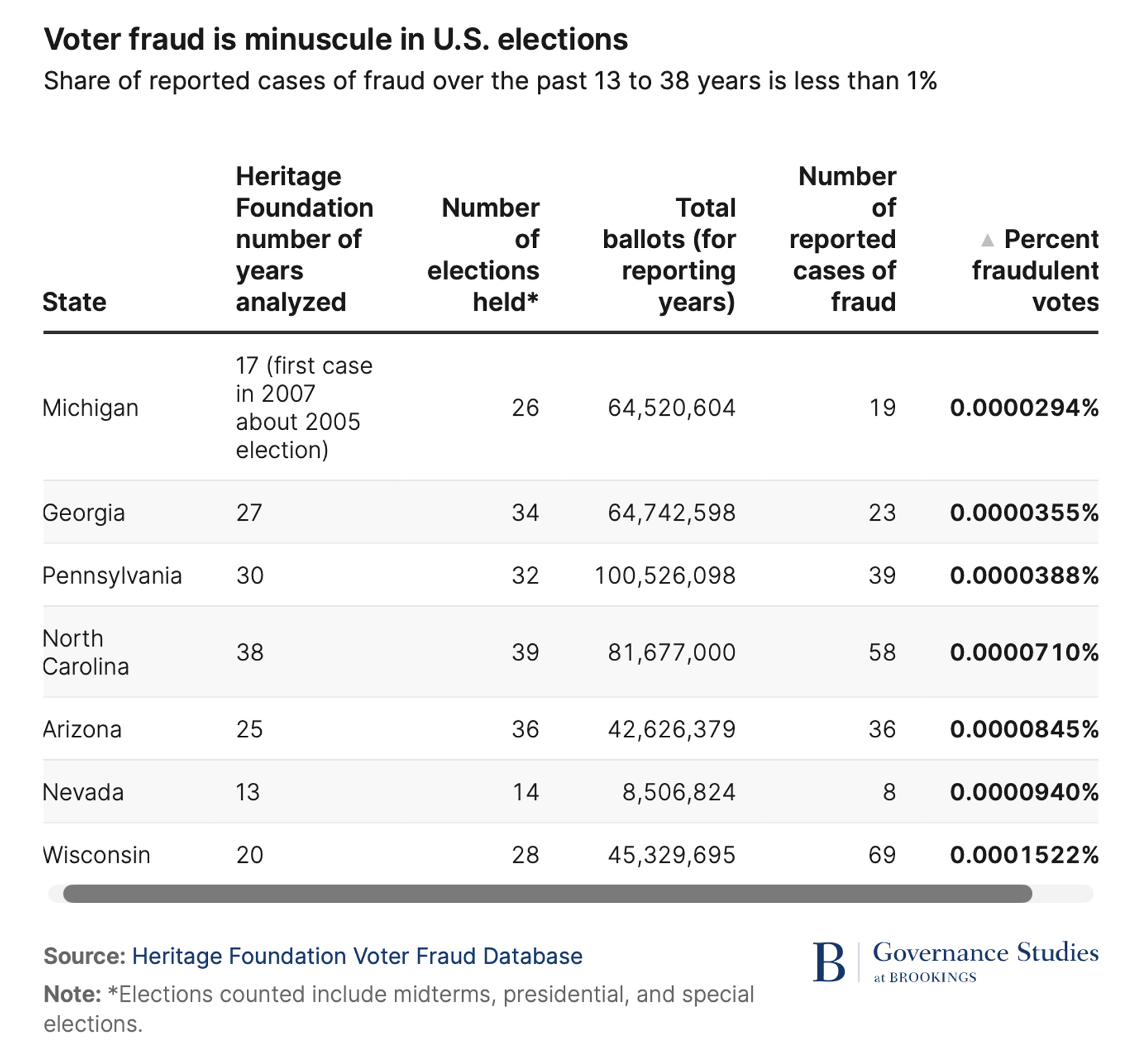
Table of voter fraud cases in U.S. elections. source: Governance Studies at Brookings
The Heritage Foundation argues that the United States has a “long and unfortunate history of election fraud” while neglecting to mention specifically that the actual instances of fraud are statistically insignificant -– evidence which shows us that this is, in actuality, nothing but a strawman argument.
It’s important to note that there are legitimate concerns relating to voting in elections in the United States, which are being addressed at the state level. That is where authority for elections, established by the Constitution, resides.
A February 2025 report by the Commission On The Future Of North Carolina Elections, in partnership with The Carter Center, details comprehensive findings and potential election reforms. As summarized in the report, “It includes analysis from election experts; comparisons of N.C. election practices with those of other states; public input on the voter experience and trust in election processes; and deliberations of committees grappling with difficult issues.”(5)
Based on a combination of polling and in-person town hall feedback, the report identifies three primary areas of concern resulting in apprehension at the forefront for North Carolina voters regarding election infrastructure security. The report identifies those three apprehensions to be:
A lack of trust and understanding in the technology behind our elections
A lack of confidence in the ballot chain of custody, and
A lack of perceived transparency in voter roll and list maintenance.
The existence of such apprehensions are not evidence by themselves that an election issue or fraud exists. Indeed, unsubstantiated claims of fraud are the most likely contributors behind those concerns. It is, however, important to address even unsubstantiated concerns, and the Commission’s report provides detailed recommendations to do so, that include:
Adequate Funding
Personnel Challenges
Civic Education and Best Practices
Voter Accessibility
Security Needs
Legislative Priorities
The Commission’s report, while focused on elections in North Carolina, could potentially serve as a blueprint for other states that have similar voting procedures and face similar voting concerns.
So, a question remains: If there are legitimate, though unsubstantiated, apprehensions that should be addressed regarding state elections, why do organizations like the Heritage Foundation resort to raising strawman claims?
I’ve written about one possible reason in a previous post: “When Authoritarians Stoke Fear and Anger…” Check it out.
Footnotes
https://www.scribbr.com/fallacies/logical-fallacy/#google_vignette
https://www.congress.gov/116/meeting/house/108824/documents/HHRG-116-JU00-20190129-SD020.pdf
https://www.brookings.edu/articles/how-widespread-is-election-fraud-in-the-united-states-not-very/
ncelectionsfuture.com. (2025, Feb. 4). “Final Report: Cross-Partisan Leaders Finding Common Ground on Fair, Safe & Secure Elections in North Carolina.”