

Lettuce Might Have Been Just the Tip of the Iceberg of Food Safety Concerns
Photo by PHÚC LONG on Unsplash
By Laurel Davis
A massive wave of cyclospora, a microscopic parasite infamous for causing severe, prolonged diarrhea, swept the country from May to September 2026. The largest cluster was tied to lettuce from Taylor Farms de México, and thousands more cases had no identified source. The outbreaks set off a tremor felt by the Centers for Disease Control and Prevention (CDC) and the entire food safety system.
According to the CDC's latest tally, posted Sept. 15, the season produced 19,883 lab-confirmed, U.S.-acquired illnesses, 1,064 hospitalizations and two (2) deaths, plus 9,765 cases still awaiting classification. That is about 17 times as many cases as the 1,180 illnesses, with no deaths, that the CDC counted in the same period of 2025. Seventeen times is a number you can't unsee.
Is our food becoming less safe? The honest answer is that nobody can say for sure. That uncertainty is the story.
The U.S. food safety system is not a formal organization and never has been. It is a decentralized, multi-agency patchwork. The Government Accountability Office (GAO) has documented at least 15 federal agencies that administer roughly 30 food safety laws. The Food and Drug Administration (FDA) oversees most foods; the U.S. Department of Agriculture's Food Safety and Inspection Service (FSIS) inspects meat, poultry and egg products; and the CDC tracks illness and investigates outbreaks but does not regulate. Their job is to prevent contamination and, if that fails, to trace and remove the contaminant quickly.
Four other factors make it hard to know in real time whether our food is safe:
Official summaries are slow. CDC's available annual outbreak summaries (NORS) stop at 2019, because the numbers are being compiled so slowly. The last all-cause estimate, from 2011, puts illnesses at 48 million and deaths at 3,000 a year.
Undercounting. Many people recover without seeing a doctor, so CDC says the true number of cases is likely higher.
Counts measure detection as well as danger. More recalls can mean more problems are being caught, not that food is worse.
Reporting lag. The CDC says cyclospora cases take about six weeks to be reported.
(Sources: CDC NORS reports; CDC Cyclospora Case Data; University of Florida Institute of Food and Agricultural Sciences [IFAS] Q&A, Sept. 10; RecallBench.com.)
On July 27, at the International Association for Food Protection's annual meeting in New Orleans, FDA Acting Deputy Commissioner for Food Donald Prater said "the U.S. food supply is safe," as cases topped 11,000, The New York Times reported.
By contrast, at the same meeting, Germán Rios, senior director of food safety and quality at Fresh Express, said, "I am concerned that we may not have really hit the peak of the outbreaks," according to the Times.
Cyclospora is only part of a bigger picture of outbreaks and recalls:
A Salmonella outbreak tied to broccoli sprouts sickened 32 people in six states, with illnesses from July 7 to Sept. 3, CIDRAP, the University of Minnesota's infectious disease research center, reported Sept. 24. (CIDRAP’s full name is Center for Infectious Disease Research and Policy.)
On Sept. 22, FSIS announced the recall of about 167,000 pounds, more than 80 tons, of raw pork, beef and goat from Star Meat Delivery, produced without federal inspection and bearing a false USDA mark of inspection.
Ajinomoto Foods North America recalled nearly 37 million pounds of frozen meals, made between Oct. 21, 2024, and Feb. 26, 2026, that may have contained glass, which investigators traced to carrots used as an ingredient, according to FSIS and Food Industry Executive’s August issue. The website 3B Media News reported no confirmed injuries.
"Our food system is under pressure like never before," said Brendan Niemira, chief science and technology officer at the Institute of Food Technologists, in a Jan. 27 FoodSafetyTech article. An added pressure is antimicrobial resistance (AMR, which CDC calls AR), that occurs when germs develop the ability to defeat the drugs designed to kill them. Resistant bacteria can pass from food animals to people, CDC says, and a March 19, 2026 review in the journal Antibiotics found that intensive agriculture plays a critical role in AMR's rise.
Then there are the federal cuts and policy changes. Did cuts to staffing and funding, along with policy decisions during President Donald Trump's second term, weaken the response to the cyclospora outbreak? An impact is disputed.
CBS News reported July 26, 2026 that Susan Mayne, former head of the FDA's food safety center, said there have been cuts, contradicting Health and Human Services Secretary Robert F. Kennedy Jr., who said there were none in the surveillance program.
Steven Mandernach of the Association of Food and Drug Officials said the cuts had "very limited, if any impact," PolitiFact reported Aug. 4.
PolitiFact also reported that Sarah Sorscher of the Center for Science in the Public Interest said federal, state and local agencies are losing qualified experts to early retirement and struggling to keep enough staff to inspect food and solve outbreaks, though upticks in recalls "could be a sign that more issues are being caught."
Here is what we know for sure:
Staff loss. During Trump's second term, the FDA has lost about 20% of its staff and CDC about 25%, CBS News reported July 26. CDC's team of cyclospora scientists shrank from 11 to three.
An advisory committee ended. The USDA terminated the National Advisory Committee on Microbiological Criteria for Foods, a scientific advisory panel, on Feb. 20, 2025. (This was noted in the USDA FSIS archive.)
FoodNet scaled back. The joint CDC-FDA-USDA program that tracks foodborne illness trends now requires reporting on only two pathogens, Salmonella and Shiga toxin-producing E. coli. Since July 1, 2025, reporting on six others, including cyclospora, has been optional. (CBS News, July 26; KFF Health News, July 28.)
The Traceability Rule delay. The FDA's Food Traceability Rule requires companies handling certain higher-risk foods to keep detailed records of where each batch came from and went, and to give them to the FDA within 24 hours of a request. Compliance was delayed to July 20, 2028, and Congress barred enforcement before then. Mayne says the rule would have helped investigators trace the lettuce contamination much faster. (Food Logistics, Jan. 7; FDA; NPR, Aug. 20; CBS News, July 26; Food Safety News, Oct. 6.)
State funding. Most state food safety programs run on FDA and CDC grants, NPR's Yuki Noguchi reported July 28. The Congressional Research Service counted $5.78 billion in terminated CDC grants to states, CNBC reported July 23. Effects vary: Kentucky says its food safety staff is down 30% to 50%, while Ohio says its cyclospora response was unaffected. (NPR, Aug. 20.)
There is some good news. RecallBench.com, a third-party tracker of FDA and USDA data, counted recalls about 15% below 2025's pace as of Sept. 17.
But PolitiFact reported Aug. 4 that pounds of recalled meat, poultry and egg products had already topped 37 million this year, against an annual average of 23.2 million over a ten year period, most of it from the Ajinomoto recall, Food Industry Executive reported.
To protect yourself from cyclospora, the CDC advises washing hands with soap and water before and after handling raw produce; washing produce under running water and scrubbing firm items with a brush; cutting away damaged areas; refrigerating cut, peeled or cooked produce within 2 hours; and cooking to at least 158°F, which can kill the parasite, as washing alone can't guarantee removal. (Sources: CDC, "Preventing Cyclosporiasis"; CDC fact sheet, Sept. 2026.)
We Are NEXT's policy paper, "A Right to Health: Day One Policy Actions for 2029," calls “cuts to science research a significant setback to health outcomes now and in the future.” It advocates a task force to restore and strengthen agencies focused on health research and policy, and stresses that rebuilding research capacity is essential to protecting public health.
The future of food safety looks at least partly cloudy. The CDC declared the Taylor Farms outbreak over on Sept. 11 and stopped weekly case updates on Sept. 15. But without required tracking, the next outbreak may arrive unannounced. Cyclospora is no longer a pathogen the FoodNet regulatory network requires states to report, and the FDA’s Food Traceability Rule won't be enforced until July 2028.
Go to our policy paper for more on how We Are NEXT proposes holding the government more accountable. We can create a future worth working toward if we commit to justice, fairness and sustainability. A better world is possible, but only if we plan for it.
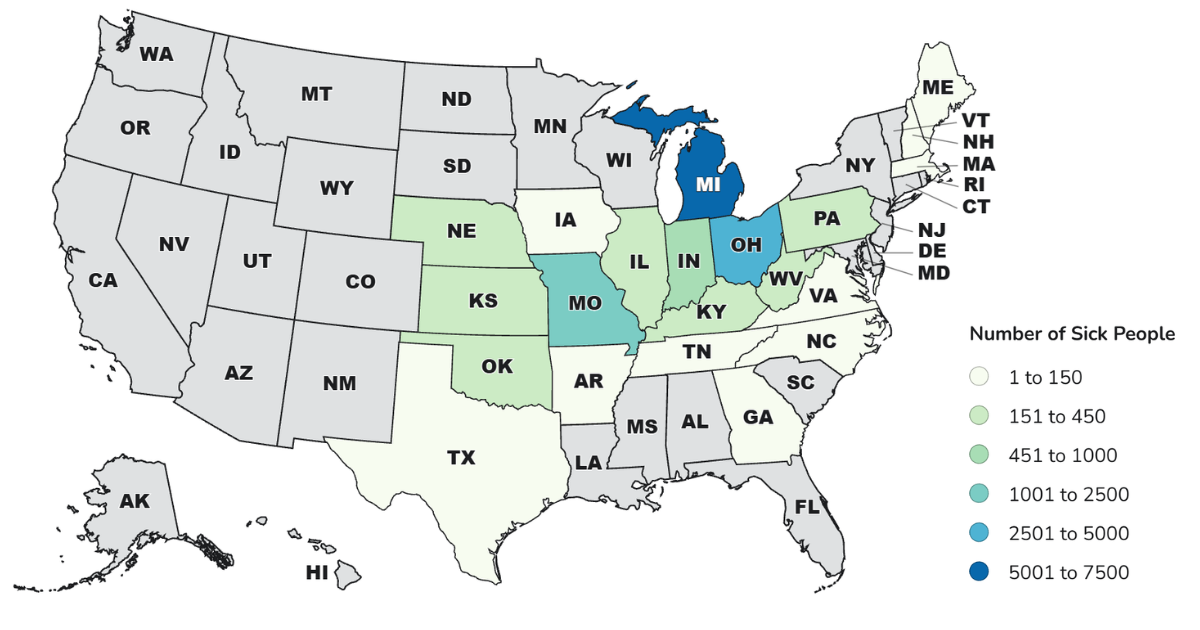
July cyclospora outbreaks by numbers and locations. Source: Centers for Disease Control
