

What Should We Do About ICE?

Photo: Public domain photo of ICE operations in Minneapolis in 2026.
Part 1 of a 3-part series
By Jo-Ann Johnston
Once, in the days following the Sept. 11, 2001 attacks on the United States, a strengthened federal agency empowered to protect the country from alien threats to our people, our property, and our democracy seemed essential.
That’s why Congress passed a 2002 law creating the Immigrations and Customs Enforcement agency in 2003. ICE reports to a parent, the Department of Homeland Security; acts as the investigative arm of DHS, and enforces immigration laws inside the country. A sibling agency, U.S. Customs and Border Protection, was created at the same time to keep ports of entry and land and sea borders secure.
Since the start of the second Trump administration in January 2025, the agencies have started acting with new urgency to carry out President Trump’s goal of cracking down on unauthorized immigration. Stalwart Make-America-Great-Again voters tend to like this objective. And Trump said federal agents would concentrate on going after migrants here unlawfully to commit violence and to deal drugs, “the worst of the worst.”
That set the stage for highly visible “surges” of masked and armed federal agents into cities big and small, workplace raids, and aggressive traffic stops. There have been daily-arrest quotas scaled up and back down; and racial profiling of targets, based not on behavior but people’s appearances and discernable jobs, has been approved by the U.S. Supreme Court since August 2025.
The fear now, even if it is not fully explained in each conversation, is that an appearance from ICE can lead to a cascade of harm, even when unjustified.
In our video age, bystander images and other footage show misdeeds and overreaches occurring in multiple places. (See the chart below.) The public has seen the shootings, physical injuries, patterns of civil rights violations, victim-blaming perpetuated by ICE and DHS when someone is hurt; children detained and families separated; and small businesses shuttered when people are too afraid to come out of the house and go to work.
Calls for accountability and oversight seem to go unheeded.
Public opinion measured
A national poll of 1,600 U.S. citizens conducted by The Economist/YouGov Poll in late July found that 54% had either only a little confidence (11%) in ICE or none at all (42%).(1) The polling organization said those surveyed indicated they were aware of recent fatal shootings involving ICE.
One of the incidents centered on 25-year-old Joan Sebastian Duran Guerrero. He was killed in a small town in Maine, on July 13, 2026, by an ICE agent while he was driving to one of his two jobs. Duran Guerrero came upon ICE agents conducting a traffic stop and he tried to get away rather than interact. He was not actually an ICE target, the government admitted.
Still, DHS said Guerrero had entered the country illegally and when he didn’t stop for ICE officers, one officer feared for “public safety” and opened fire.(2)
Guerrero was a married dad with a toddler and a work permit.
The officer worried about public safety was David Brouillette. Questions about him continue. He is twice divorced, also a father, and was discovered by the Associated Press to have a history of domestic violence reports shown in family court records from Maine.(3)
Other issues turned up in Brouillette’s record as well, such as having credibility issues when appearing in court. Eventually, Tom Homan, the Trump administration’s “border czar,” admitted on television that Brouillette should not have made it through the hiring process.(4)
The case was similar in many ways to the July 7, 2026 shooting in Houston, where an ICE officer fatally shot homebuilder Lorenzo Salgado Araujo. He was not actually a DHS target. Araujo was driving himself and others to work at their construction jobs and he looked like someone the agency was trying to find, according to media reports.
DHS said the driver’s own conduct -– allegedly ignoring officer commands and then trying to run over an ICE officer — prompted an agent to shoot in self-defense. The officer responsible for the shooting was not identified.(5)
When the respondents to The Economist/YouGov Poll opened their surveys, 60% said they had heard about these killings. Fifty-eight percent said ICE was using too much force in its operations. But opinions differ according to party affiliation: 91% of Democrats and 63% of independents said ICE had used too much force, compared to only 19% of Republicans.(6)
Footnotes
YouGov.(2026, July 17-20). “The Economist/YouGov Poll,” results chart. https://d3nkl3psvxxpe9.cloudfront.net/documents/econTabReport_ESdiNMa.pdf
Spoto, S. Carpenter, M. (2026, Aug. 17). “Family Presses for Information About Fatal ICE Shooting in Maine.” The New York Times. https://www.nytimes.com/2026/08/17/us/biddeford-maine-ice-shooting-hearing.html
Brook, J, and others. (2026, July 17). “ICE Officer in Maine shooting has history of violent behavior, family and records say.” Associated Press.https://apnews.com/article/ice-david-brouillette-johan-guerrero-maine-shooting-dbc30d6d59e2a95fb470afc188e125c6 Juy 17, 2026.
Yang, M. (2026, July 23).” Trump ‘border czar’ says ICE officer in Maine killing should not have cleared vetting.” The Guardian. https://www.theguardian.com/us-news/2026/jul/26/trump-border-czar-ice-officer-maine-killing-vetting
Oyekanmi, L. and others, Associated Press. (2026, July 10). “What to know about the fatal shooting of Lorenzo Salgado Araujo by ICE.” Associated Press on PBS News Hour. https://www.pbs.org/newshour/politics/what-to-know-about-the-fatal-shooting-of-lorenzo-salgado-araujo-by-ice
YouGov. Same results chart, https://d3nkl3psvxxpe9.cloudfront.net/documents/econTabReport_ESdiNMa.pdf
ICE/CBP Cases That Left Fear and Mourning Behind
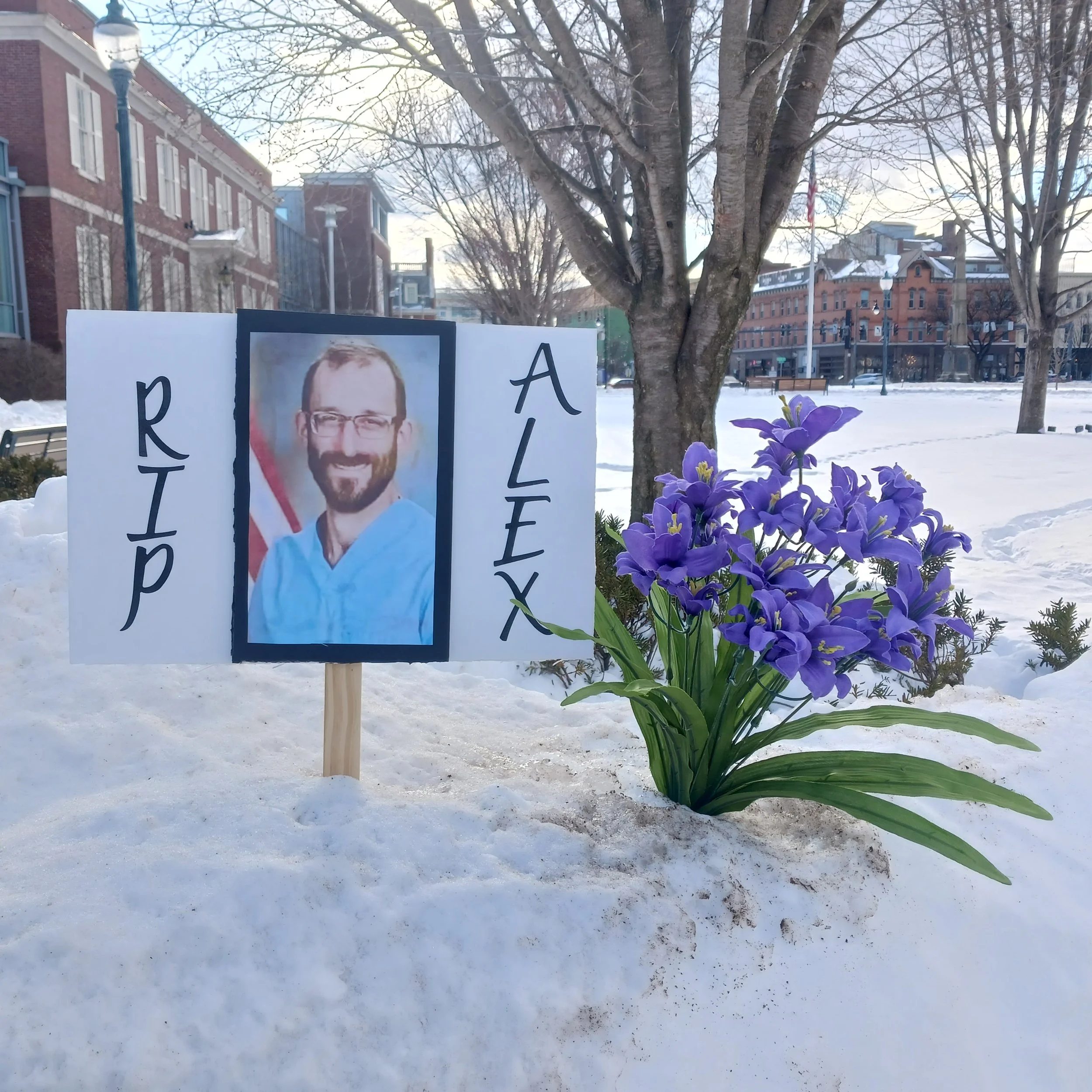
Image: A photo of Alex Pretti was left behind at the site of a vigil held in upstate New York.
Deaths
Renee Good -- Citizen, Minneapolis neighborhood observer. Shot by ICE three 3 times while in her car. A doctor at the scene was ordered not to aid her. Jan. 7, 2026.
Alex Pretti, RN -- Citizen, Minneapolis, VA nurse. Surge observer, on foot assisting a woman shoved to the pavement. He had a camera in one hand. Legally carried firearm in a holster around his waist. Tackled, disarmed, hit, shot multiple times, CBP officers, Jan. 24, 2026. Recommended viewing: Pretti’s family speaks in an ABC News interview. https://abcnews.com/US/family-alex-pretti-speaks-exclusive-interview-murdered-child/story?id=135910349
Nurul Amin Shah Alam -- A 56-year-old nearly blind Rohingya refugee originally from Burma, in the U.S. since December 2024. Medically vulnerable beyond his blindness, and spoke little English. Was found dead on a downtown Buffalo street in mid-winter, days after U.S. Customs and Border Protection (CBP) agents dropped him off at a closed coffee shop late at night, away from his family home, without notifying the family. The Erie County Medical Examiner found that hypothermia and dehydration gave Shah Alam an ulcer, bringing about his death, and ruled the man's death a homicide. But the examiner also said the homicide finding does not necessarily mean a crime was committed. Shah Alam was declared missing Feb. 19, 2025. Recommended reading: https://investigativepost.org/2026/02/25/blind-refugee-abandoned-by-border-patrol-is-dead/
Lorenzo Salgado Araujo -- A homebuilder originally from Mexico, had been working in the U.S. for decades. Died in Houston at the site of a traffic stop. He was driving himself and his construction workers in a van to their job and was shot by ICE. But Salgado Araujo was not the intended target, DHS admitted. July 7, 2026.
Joan Sebastian Duran Guerrero -- Originally from Colombia, he was working and living in a small town in coastal Maine. He was driving to work and was shot when he tried to bypass an ICE traffic stop. He was not ICE's intended target. July 13, 2026.
Injuries reported
Two young men, ages 21 and 31, each lost sight in one eye after being hit by federal agents with "less-lethal'' projectiles used for crowd control during a protest in Santa Ana, Calif. The protest was organized against ICE, following the shooting death of Renee Good in Minneapolis. The agents who fired the shots were not identified in the media; one of the injured men said he was fired upon by a DHS officer. Jan. 9, 2026.
During the continued Minnesota surge, ICE officer Christian Castro shot a man through a closed door and wounded him in the leg. The man who was hurt is 24-year-old Julio C. Sosa-Celis, from Venezuela. He was outside his home when ICE arrived. ICE had been chasing the housemate of Sosa-Celis, and caught up with the two on the lawn and scuffled. But Sosa-Celis and his housemate managed to get inside and shut the door behind them. Castro opened fire through the closed door. Castro later claimed he fired in self-defense after being threatened with a broom and snow shovel, but video disproved his story. The case against Castro became complicated and is not yet resolved. Date of shooting: Jan. 14, 2026.
An unnamed protestor was injured when someone driving an ICE vehicle outside the Delaney Hall detention facility in Newark, N.J., allegedly ran over the protestor's foot. She was taken to a hospital for surgery but declined to give her name. This happened at the end of a weekly prayer vigil outside the hall on Aug. 31, 2026. It has a higher rate than other facilities of detainees dying. The area just outside the detention facility has been a continuing site of protests as migrant advocates try to keep attention focused on the facility.
Sources: Compiled from media reports