


This is the second entry in a three-part blog series,“How ICE Spent a Billion Dollars and Walked Away”
By Alice Bond
After spending almost $1.1 billion in taxpayer money to purchase 11 facilities with a total of 8 million square feet, ICE contracting began almost immediately and proceeded at a furious pace.
ICE planned to retrofit one warehouse in Social Circle, GA, according to the American Immigration Council, into a two-level facility with a custom-built waste water treatment center, massive cell blocks, and a staff gun range. Major renovation contracts followed by March 2026, according to digital news outlet “NOTUS” and “Engineering News-Record.” Lawsuits and environmental reviews stalled progress, according to “Project Salt Box” and “Prism News.”
Then came the collapse. Seven of the warehouses, with a combined purchase price of $700 million according to “The New York Times,” were gradually being shuttered. By March 24, U.S. Senator Markwayne Mullin of Oklahoma was sworn in as a new DHS Secretary, inheriting, and then pausing, the warehouse program.
According to reporting by CNN and “Spotlight PA,” the shift appeared to be poorly communicated to media and surrounding communities, with no formal DHS statement.
The news reached affected towns over weeks through congressional representatives and media reports, according to CNN, “USA Today” and the Associated Press. ICE now plans to sell or transfer to other federal agencies any of these facilities that no other agency wants, according to “Planetizen” and “The New York Times.” Facility operators vanished into the ether. And the administration was silent.
Their modest names and bucolic locations — tucked in hills and dells across the countryside: Social Circle and Oakwood/Flowery Branch, Georgia; Upper Bern Township and Tremont, Pennsylvania; Romulus, Michigan; Roxbury, New Jersey; and Salt Lake City, Utah — are a far cry from the harsh reality of repurposing the warehouses there as detention centers.
A Salt Lake County mayor's office spokesperson, Eric Biggart, told CNN that as late as Friday, June 19, 2026, their office had not received confirmation from DHS on the status of their local facility.
The Utah Democratic Party said in a statement that "the decision to now sell or abandon these facilities is fiscal recklessness and an insult to every taxpayer."
Sassa, the deputy policy chief of Project 2029, agreed: “For an administration that rhetorically claims to pride itself on government efficiency, this figure marks an incredibly wasteful amount that could largely be prevented through more efficient, humane, and Alternative to Detention (ATD) practices ”
Those alternatives — including check-in apps and electronic tagging or tracking — are options that can entirely prevent the warehousing of individuals, according to the American Immigration Council.
Alternatives to Detention Practices are also cited as preferable management methods in Project 2029’s own suggested policy for reform of the immigration system, available in the policy section of this website.
Unexpected factors
But what led DHS and ICE to scrap their $700 million warehouse plan?
A mix of forces consigned the entire program to costly failure. Seven federal lawsuits were filed, according to the American Immigration Council, “Spotlight PA” and PBS News. The warehouses were supposed to provide capacity quickly but, as reported by AP, PBS News and ABC News, the speed of the plan left federal officials exposed to lawsuits, local zoning fights, and environmental challenges.
The reaction of local residents was broad and fierce according to CNN and local reporting. Protests took place in Social Circle, Georgia; Roxbury, New Jersey; Romulus, Michigan; and Salt Lake City, Utah.
An advocacy group, Detention Watch Network, reported a national day-of-action under the banner "Communities Not Cages." Citizens voiced deep concerns. "They're saying, 'I want our community to be safe, but this is not the way to do it,'" said the Reverend Dallas Anne Thompson, a Presbyterian Church USA supply pastor who organized Lenten Prayer vigils outside the ICE warehouse sites in Oakwood and Social Circle, Georgia, according to the “The Christian Science Monitor,”April 21, 2026.
Although lawsuits and protests raised the awareness of the ICE warehouse detention program among the general public, the story of the policy plan and its consequences does not end there. The economic effects unleashed by the initial $170.7 billion DHS budget allocation raise important questions: the identities of the property sellers, and their relationships to President Donald J. Trump.
According to “Project Salt Box” and “More Perfect Union,” a consistent pattern runs across the warehouse purchases: ICE paid prices that exceeded both prior property values and market comparables at nearly every site. The transactions tell that story. Here were the seven being offloaded:
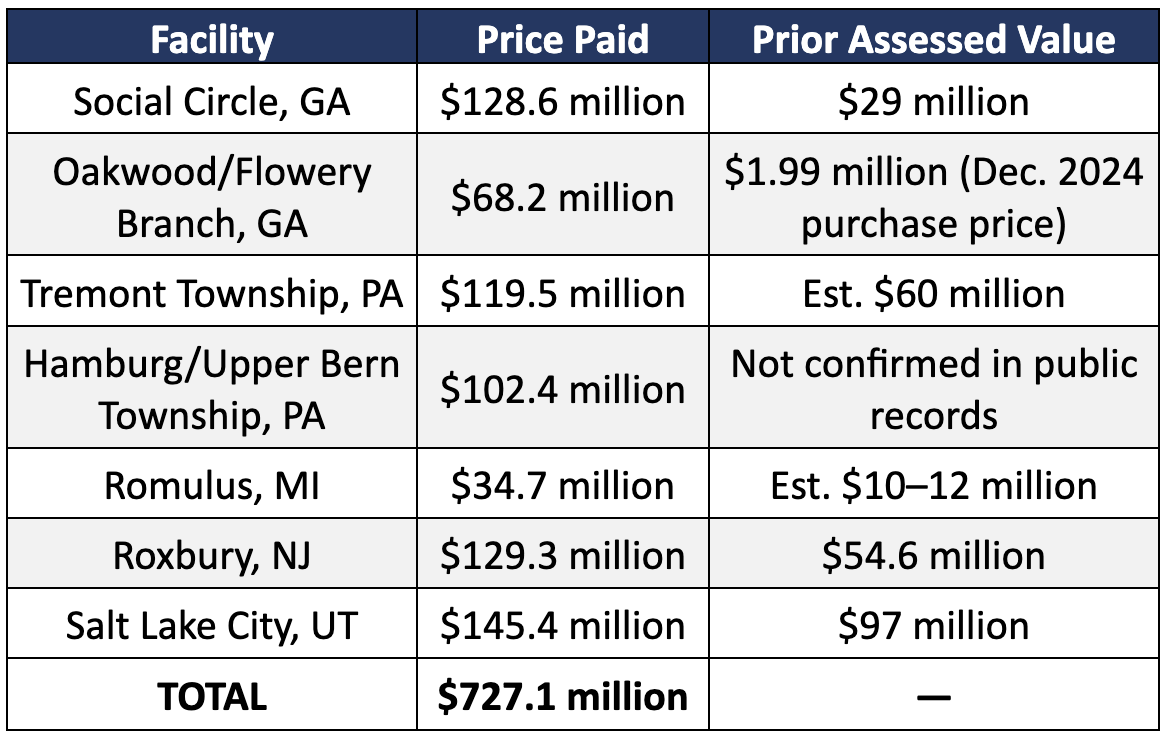
Note: Oakwood/Flowery Branch prior value reflects December 2024 land acquisition cost, not a formal assessed value. Hamburg/Upper Bern prior assessed value not confirmed in public records.
Investigations by “Project Salt Box” and “More Perfect Union” indicated that many of the facilities sat vacant for extended periods and were reported as underperforming in financial filings by their institutional owners. The consistent and considerable gap between the prices paid and prior values shows that sellers received returns dramatically above fair market value. These two media outlets, along with others, are continuing to investigate the purchase of these facilities by DHS under this administration.
Because DHS paid so far above market, it is unlikely to recover anything close to its purchase prices on resale — meaning these transactions could represent a loss of hundreds of millions of dollars for American taxpayers.
In March 2026, CNN reported that the DHS Office of Inspector General opened an investigation into alleged corruption in contracting under former Secretary Kristi Noem, including the role of her advisor Corey Lewandowski. In May 2026, the DHS Office of Inspector General confirmed to “The Wall Street Journal” that it had opened a separate formal audit of the warehouse purchases specifically, to determine whether ICE “met its operational needs in a cost-effective manner.”
Reported by the “New York Times” and confirmed by AP, ICE first planned to get rid of seven of the 11 warehouses — either giving them to other federal agencies or selling them.
They appeared to be “moving forward” with the remaining four of the original 11, meaning to bring them online as detention centers, according to Detention Watch Network. But one of those four was redesignated for administrative use.
As of June 2026, none of the four remaining were operating as detention facilities according to the U.S. Rep. Veronica Escobar of Texas, who was briefed by Acting ICE Director David Venturella.
At this point, after all the expenditures and upheaval, none of the seven warehouses had been designated or operated as detention centers. But on July 11, it appeared as though DHS would potentially bring one of the abandoned warehouses online as a detention center, leaving only six for sale or give-away. Nine days after announcing they would sell the one in Roxbury, New Jersey, DHS had reconsidered. According to “The Jersey Vindicator,” in a reversal that shook the community, DHS intended “to move forward with plans to consider the retrofitting of Roxbury Township warehouse facility for use as a detention facility.”
According to court filings and federal planning documents as reported by “The Jersey Vindicator,” the massive building contains four toilets and is without adequate access to the water and sewer infrastructure. The facility is indicated as being able to hold as many as 1,500 detainees.
The fallout of the abandonment of the facilities was straightforward: the sellers reaped profits dramatically above market value, while taxpayers faced a write-off — of potentially hundreds of millions of dollars — on a combined purchase price, confirmed by “The New York Times,” of $700 million.
This ends Part II of this blog series, which is divided into three entries. Next comes a broader overview of the agency’s results.