

Gimme Shelter: How The New Housing Bill Works for You

Photo: Troy Mortier on Unsplash
By Alice Bond
The bipartisan “21st Century ROAD to Housing ACT,” which officially became law on July 11, 2026, is the biggest federal housing overhaul in decades.
And it landed none too soon.
Approximately 42.5 million households — 33% of all U.S. households — fell into what’s known as the “cost burdened” category, according to a June 11, 2026 USAFacts report, based on 2024 U.S. Census Bureau/American Community Survey data. In plain speak: more than one in three Americans spent more than 30% of their income on housing. That number is the government's line in the sand for what counts as affordable.
In addition, the U.S. Department of Housing and Urban Development’s (HUD) 2025 Point-in-Time Count found that more than 745,000 people were homeless on a single night in January 2025 — roughly a population the size of the city of Portland, OR, or Baltimore, MD, without a home. And that’s up 27% since 2013.
There is a growing sense of frustration and pessimism. Seventy-three percent of Americans told the Harris Poll’s 2026 “State of Real Estate” report that large “investor activity is causing housing shortage and rising costs,“ while 63% of Americans say they “don’t believe that housing prices will become affordable again.”
"Americans,” the report states, “haven't just lost confidence in the housing market, they've lost confidence in the systems around it."
So, what does the ROAD Act do? To find out, we stacked it up against Project 2029’s “Housing is a Human Right,” housing plan to see where they agree — and where they don’t. One important caveat: the ROAD Act is real, signed law. And the Project 2029 document is still just a proposal — a road map for what can happen down the line.
Housing Policy Comparison: The ROAD Act vs. Project 2029
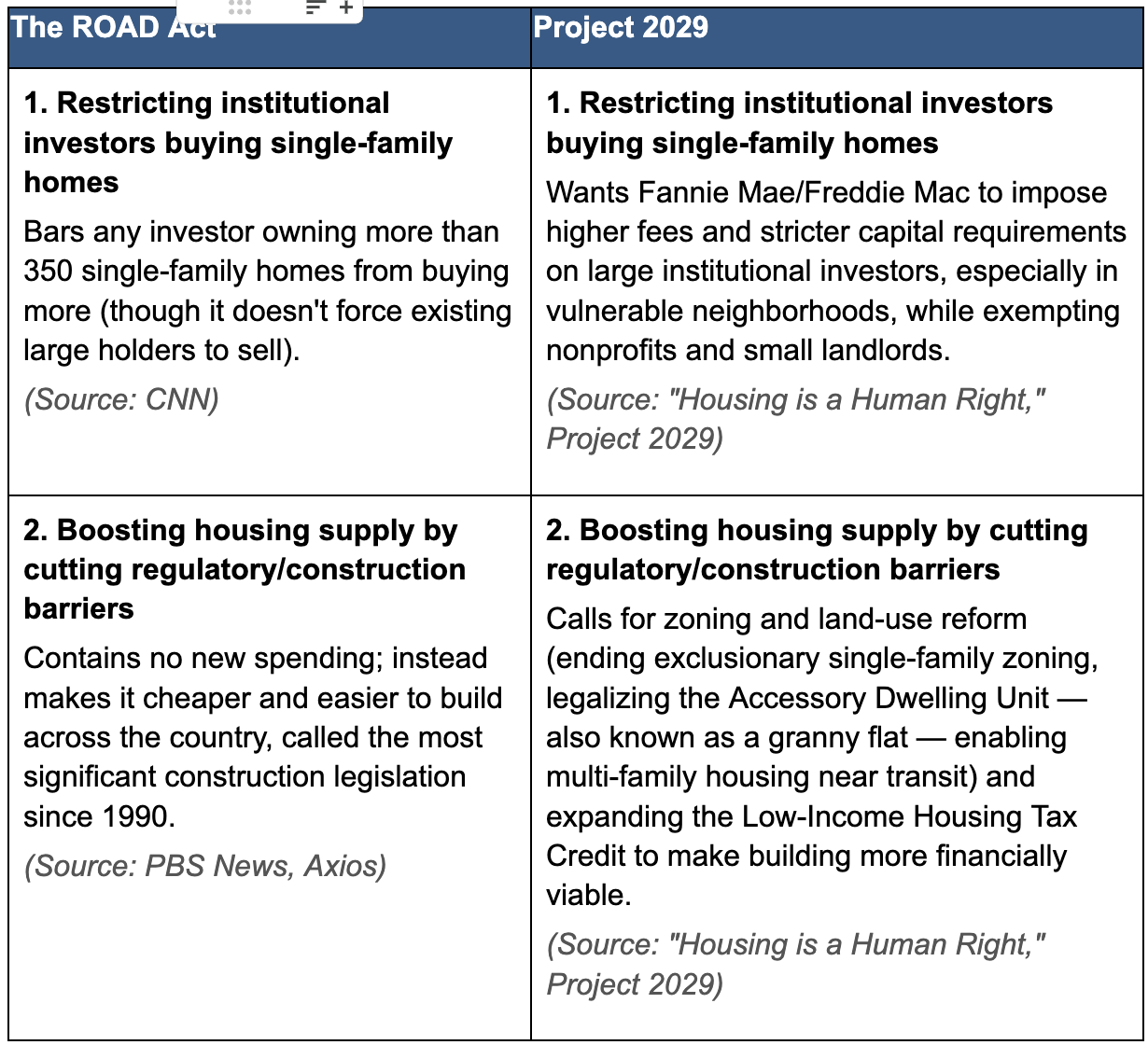
Areas of overlap between the 21st Century ROAD to Housing Act and Project 2029's "Housing is a Human Right" proposals
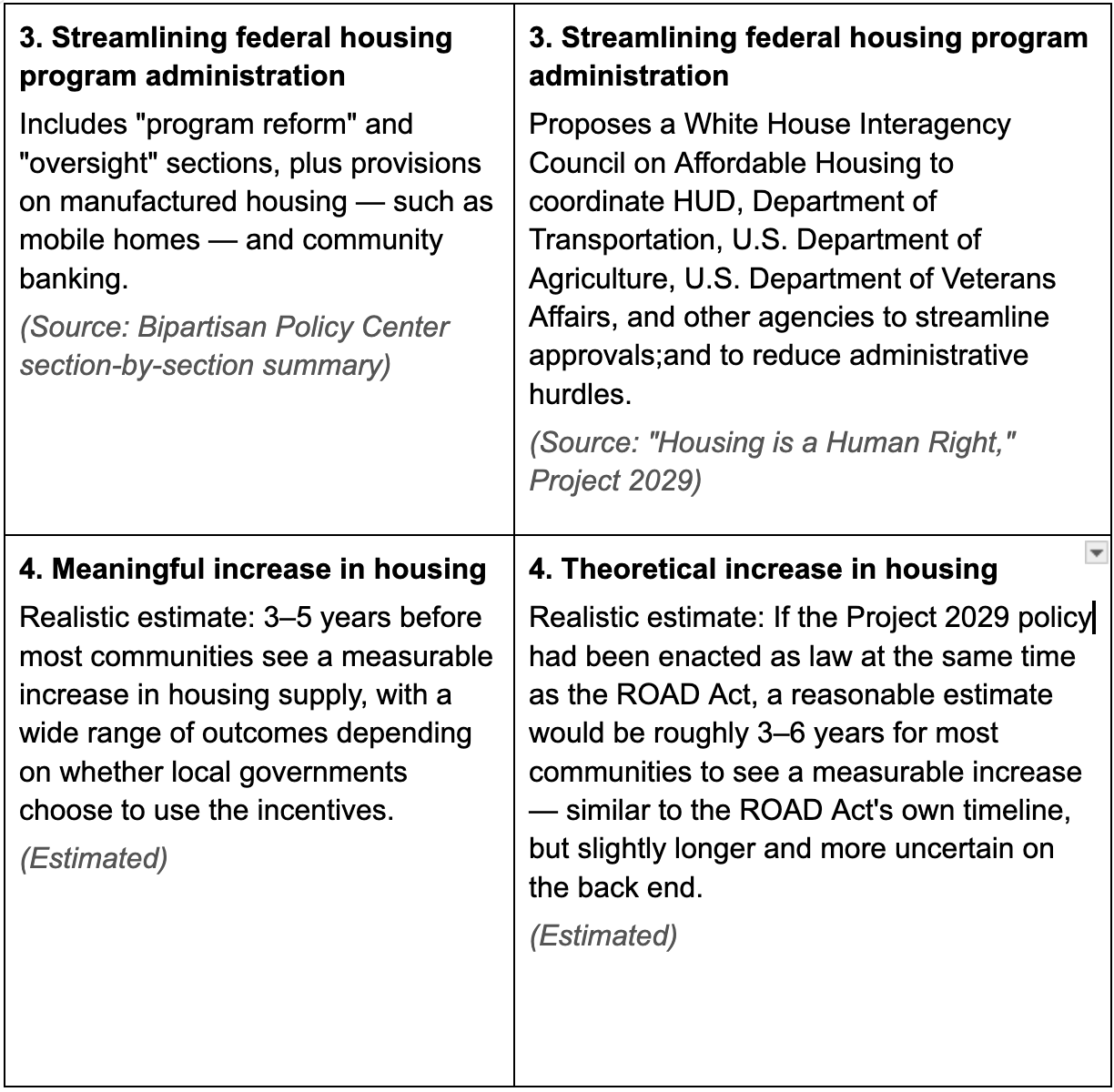
Areas of overlap between the 21st Century ROAD to Housing Act and Project 2029's "Housing is a Human Right" proposals
According to the Center on Budget and Policy Priorities (CBPP), the housing crisis Americans find themselves in today is mainly the result of two problems: a shortage of units being built and an affordability gap where available homes are out of reach without financial help for renters and buyers.
The ROAD Act and the Project 2029 “Housing is a Human Right” plan agree on one thing: build more homes. Both offer supply-side fixes, which means boosting economic growth by reducing the cost of building.
Both take aim at big investors buying up single-family homes — part of the reason that the shortage exists. The ROAD Act puts a hard cap on buying housing — barring purchases past 350 homes. Project 2029 uses financial disincentives. This makes buying more expensive or harderfor large investors by directing Fannie Mae and Freddie Mac, federal entities that back most U.S. mortgages, to charge higher fees and require them to hold more capital in reserve.
And both sides agree that the federal housing system itself is bogged down in red tape.
There are other differences. While “Housing is a Human Right” is a policy for use in the future, it still works more broadly in scope, reaching far beyond The ROAD Act, which focuses almost entirely on increasing the supply of homes by using construction reform.
Unlike the ROAD Act, Project 2029 calls for:
Investment in renter protections;
Stepped-up anti-discrimination enforcement;
A broader, more robust homelessness policy;
A prohibition against algorithmic rentsetting to prevent price-fixing;
Stronger rules against lending bias with enforcement capabilities of equal strength;
And investment in climate resilience strategies, including building codes and financial protections.
What do experts say? Despite bipartisan praise from lawmakers in Washington, some industry sources and economists say that an increase in housing from the Road Act wouldn’t move the needle much. They also agree that the overall impact may be too small and too slow.
According to American Banker, “despite its broad scope, housing experts say the legislation is unlikely to significantly ease the nation’s housing shortage or make homes substantially more affordable.”
And Redfin’s chief economist, Daryl Fairweather, pointed out the possibility of institutional investors avoiding the ROAD Act’s investor cap altogether, saying investors “could skirt the ownership cap by splitting their holdings into smaller entities.”
In the end, the 21st Century ROAD to Housing Act was, according to the Bipartisan Policy Center, forged “after months of back-and-forth between the Senate and the House,” when “the two chambers reached an agreement on a comprehensive bipartisan housing package."
And all this comes with a very significant separate provision, Section 1202, which "clarifies that no additional funds are authorized to implement the bill."
Project 2029 is ready to hit the ground running when it becomes real policy. We are developing immediately actionable policies to reform our country on Day One in 2029. For more on the full “Housing is a Human Right” policy, click here.
